


Aug. 06, 2026 | 4 Minute Read
Key Takeaway
European automakers face stiff competition in local markets from Chinese imports, contributing to our deteriorating fundamental outlook.
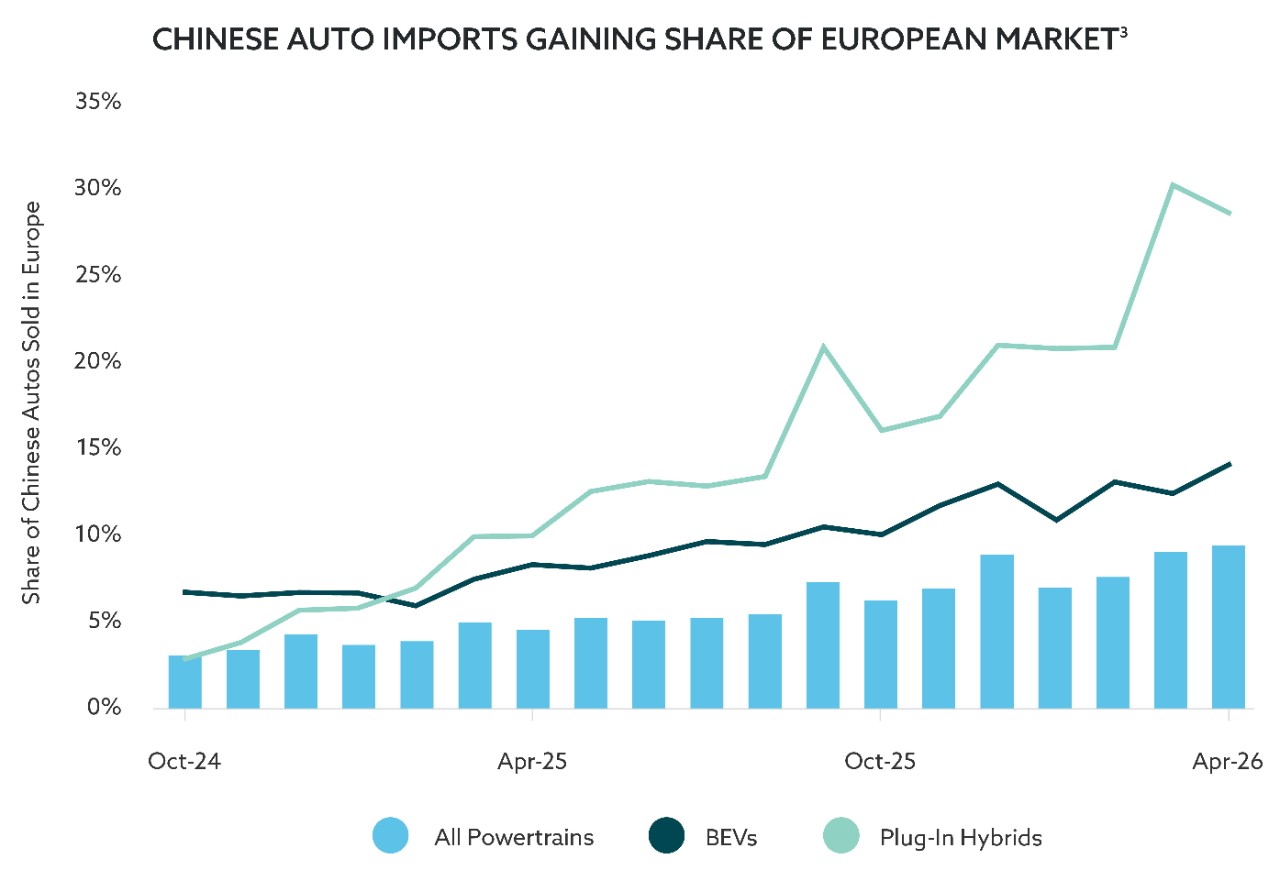
With the Q2 earnings season underway, we believe now is a good time to take a more in-depth look at the dynamics shaping the European auto market and the outlook for the sector overall. Most prominently, May 2026 marked a potentially telling milestone for the sector as Chinese imports made up 10% of new car purchases in the European Union (EU) for the month, up from nearly 6% in May 2025.1
For newer technology powertrains, the numbers are even more notable to us. 15% of all new battery electric vehicle (BEV) purchases in May were Chinese imports, versus 10% last year.1 That number increases to almost 25% for new hybrids (including plug-in hybrids) bought during the month, up from almost 10% in May 2025.1 This increase in purchases coincided with Chinese passenger vehicle exports jumping nearly 80% year-over-year worldwide.2 This uptick in exported units was aided in part by lower electric vehicle incentives and weaker local consumption in China, coupled with overproduction by Chinese original equipment manufacturers (OEM).
The Price Is Right
In our view, European consumers are drawn to Chinese cars due to their advanced-technology features (e.g., advanced driver assistance and modern high-voltage charging systems) and more affordable price points. On average, these imports sell for approximately 20% less than their EU peers.4
Government policies play a role in these price discrepancies, in our opinion. In 2024, the EU implemented special tariffs (around 35% or less) against Chinese BEVs. However, plug-in hybrids remain untariffed (aside from standard EU import tariffs of 10%) and also benefit from local EU subsidies for lower emission vehicles. Meanwhile, local EU OEMs are struggling to compete against these products due to high regulation, taxes and labor costs. We note that many European automakers are pushing for less stringent emission regulations from the EU to buy themselves time.
As for the United Kingdom (UK), no special tariffs against Chinese cars of any sort currently exist, helping Chinese automakers capture roughly 15% of 2026 new car purchases in that market through May.5 In general, Chinese companies are most successful in the UK, Italy and Spain and are gaining ground in France and Germany, from our observations.
Traffic Ahead
Volkswagen and other EU automakers have announced yet another round of plant rationalization and restructuring, but we doubt this will be enough to fully offset sector profitability headwinds. As a result, we believe the fundamental outlook is deteriorating. We now look to the rest of the year for updates on how OEMs may try to counteract these competitive forces led by Chinese imports.
Author
David Snowden, CFA
Credit Analyst
(1) Bloomberg and Dataforce. Based on unit sales in EU, EFTA countries and UK. Chinese brands include Polestar, DR, Evo, Chery-Ebro and Stellantis-Leapmotor ventures; Smart is excluded. June 2026. (2) Bloomberg. Total Passenger Vehicle Exports – China. As measured by units sold from 1 July 2024 to 30 June 2025 compared to 1 July 2025 to 30 June 2026. (3) Bloomberg Intelligence. Based on unit sales in Europe. 8 July 2026. (4) EV China. “Chinese Electric Cars Europe: Brands, Tariffs, Buying 2026.” 28 January 2026. (5) Auto Express. “China beats Japan and Korea: Chinese cars now more popular with UK buyers.” 4 June 2026.
Unless otherwise stated, the information presented has been prepared from market observations and other sources believed in good faith to be reliable. Information and opinions expressed by PPM are current as of the date indicated and are subject to change without notice. Forward-looking statements are subject to uncertainties that could cause actual developments and results to differ materially from the expectations expressed.
Past performance is no guarantee of future results. Investments involve varying degrees of risk and may lose value.
© 2026 PPM America, Inc. All rights reserved.

