


September 22, 2026 | 4 Minute Read
Key Takeaway
In a results-driven business, we believe building and maintaining relationships with broker-dealers is a key to success when trading on behalf of our clients, even for large and complex portfolio trades.
Recently, PPM's trading team executed a $1.5B portfolio trade (PT) – more than double our previous high. The trade is a timely lens for examining how PTs have evolved in the credit market and how PPM's relationship-driven approach to trading benefits our clients.
Simply put, PTs enable institutional investors to aggregate bond trades (both buy and/or sell orders) to transact as one single order, mitigating execution risk and potentially reducing transaction costs. The electronification of the credit market has facilitated the increased use of PTs in recent years.1 Five years ago, this $1.5B trade may have taken roughly five hours to complete. A spreadsheet of the proposed transactions would have been sent to various broker-dealers who would then respond with their execution strategy and costs. Now, however, a trader can model the PT using Blackrock’s Aladdin® investment management system, load it on a trading system and then choose the broker-dealers to transact either all or part of the basket of trades.
Typically, we get up to eight execution price comps for PTs. But, in our view, the size of this trade made it preferable to go to a smaller number of broker-dealers. The trading team then identified which broker-dealers met the following criteria: 1) had properly executed previous PPM PTs at competitive cost, 2) had handled trades of this size, and 3) had expertise in the sector in which we were trading. Ultimately, this approach proved successful, as we were able to execute the trade at a 40% discount from what we had discussed with the client.
Being able to trust broker-dealers to handle large, complex trades at favorable costs does not happen overnight. In our view, it is a result of PPM's core practice of building relationships with "the street" – the individuals that make up the collection of broker-dealers responsible for trade execution. For a simpler, smaller size trade (e.g., a $1M buy order for one bond), we could put it on an electronic trading platform where 60 dealers can see it. By doing so, we can secure the best execution price, but the trade-off is that a lot of other entities would have sight into what we are doing.
Instead, we can elect to go the less visible route – pick up the phone and do a voice trade. By continually interacting with broker-dealers, we strive to forge a rapport with the people behind the trades. We believe this not only benefits our clients through favorable secondary trade execution but also gives PPM higher consideration when it comes to allocations in the primary market.
It may sound simple, but our goal at PPM is "to do it the right way" – understanding the various tools in our trade toolkit (e.g., competitive and less-competitive PTs, electronic trading, voice trades, etc.) and discerning which one fits the situation at hand. The sheer size of this $1.5B PT gave us the opportunity to try a new trading approach and thereby expand that toolkit, but its proper execution also depended on the other half of the equation: our continuous emphasis on building and maintaining relationships with "the street." Understanding the nuances of our broker-dealers only comes from transacting and interacting with them on a personal level, something we believe has become deemphasized by many of our competitors.
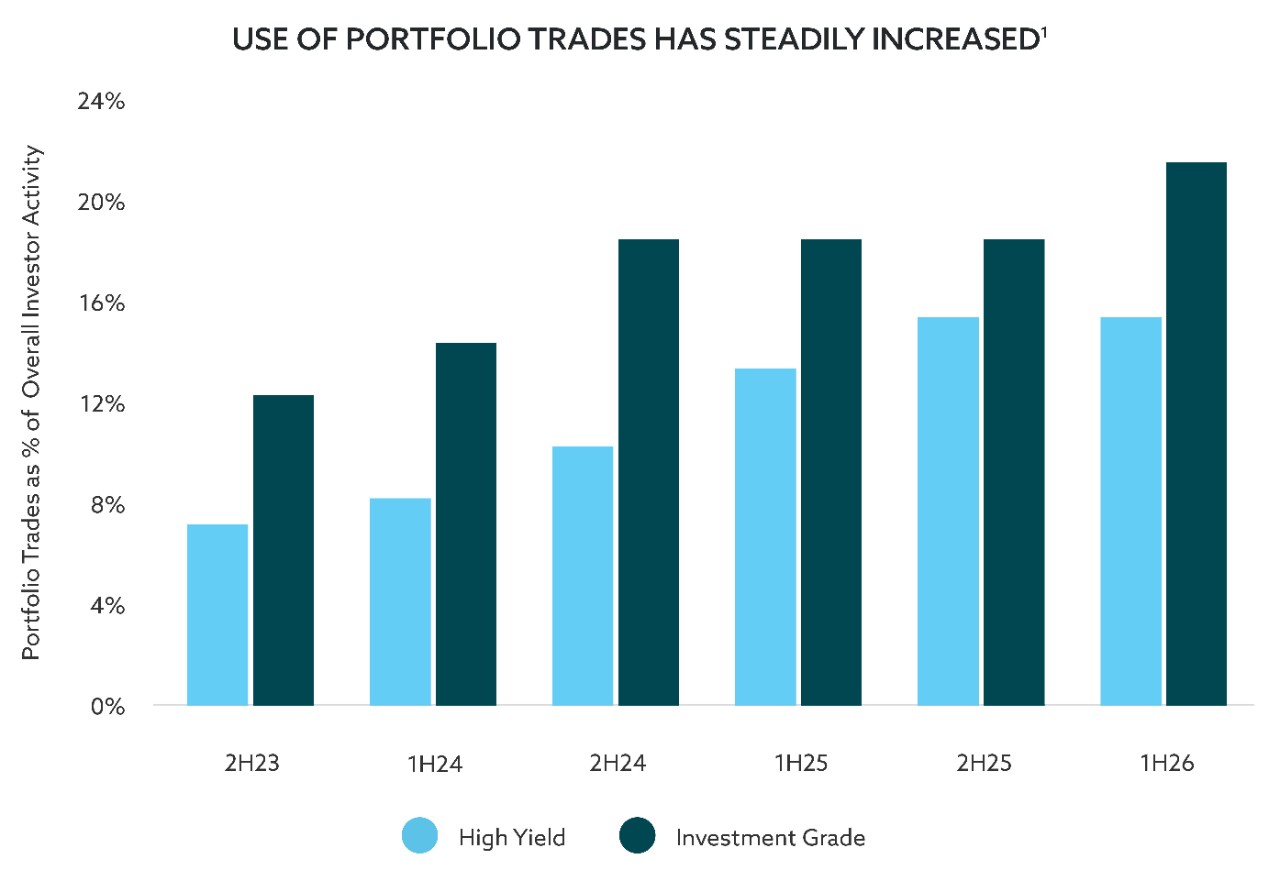

(1) J.P. Morgan. “US Credit Market Liquidity: 1H26 Update.” 23 July 2026.
Unless otherwise stated, the information presented has been prepared from market observations and other sources believed in good faith to be reliable. Information and opinions expressed by PPM are current as of the date indicated and are subject to change without notice. Forward-looking statements are subject to uncertainties that could cause actual developments and results to differ materially from the expectations expressed.
Past performance is no guarantee of future results. Investments involve varying degrees of risk and may lose value.
© 2026 PPM America, Inc. All rights reserved.

