


Aug. 05, 2026 | 6 Minute Read
Key Takeaway
We believe several structural issues must be addressed before a meaningful rebound in Chinese consumption can take hold.
China’s second quarter real GDP growth slowed to 4.3% year-over-year, offsetting stronger first quarter growth.1 Taken together, growth for the first half came in at 4.7%, on track to meet the headline growth target set forth in China’s 15th five-year plan. However, the underlying drivers of that growth seem to be uneven. The consumer sector has struggled to recover since the COVID lockdowns. Despite announced government efforts to support demand, we believe several structural issues must be addressed before a meaningful rebound in consumption can take hold.
Income Uncertainty Is Weighing on Consumption
From our observations, the primary drag on consumer spending is uncertainty around household income prospects. China’s labor market was already under pressure from the government-led regulatory crackdown on the private sector, the property-sector downturn and weaker hiring by foreign companies. COVID lockdowns added further strain by forcing many small and medium-sized enterprises out of business.
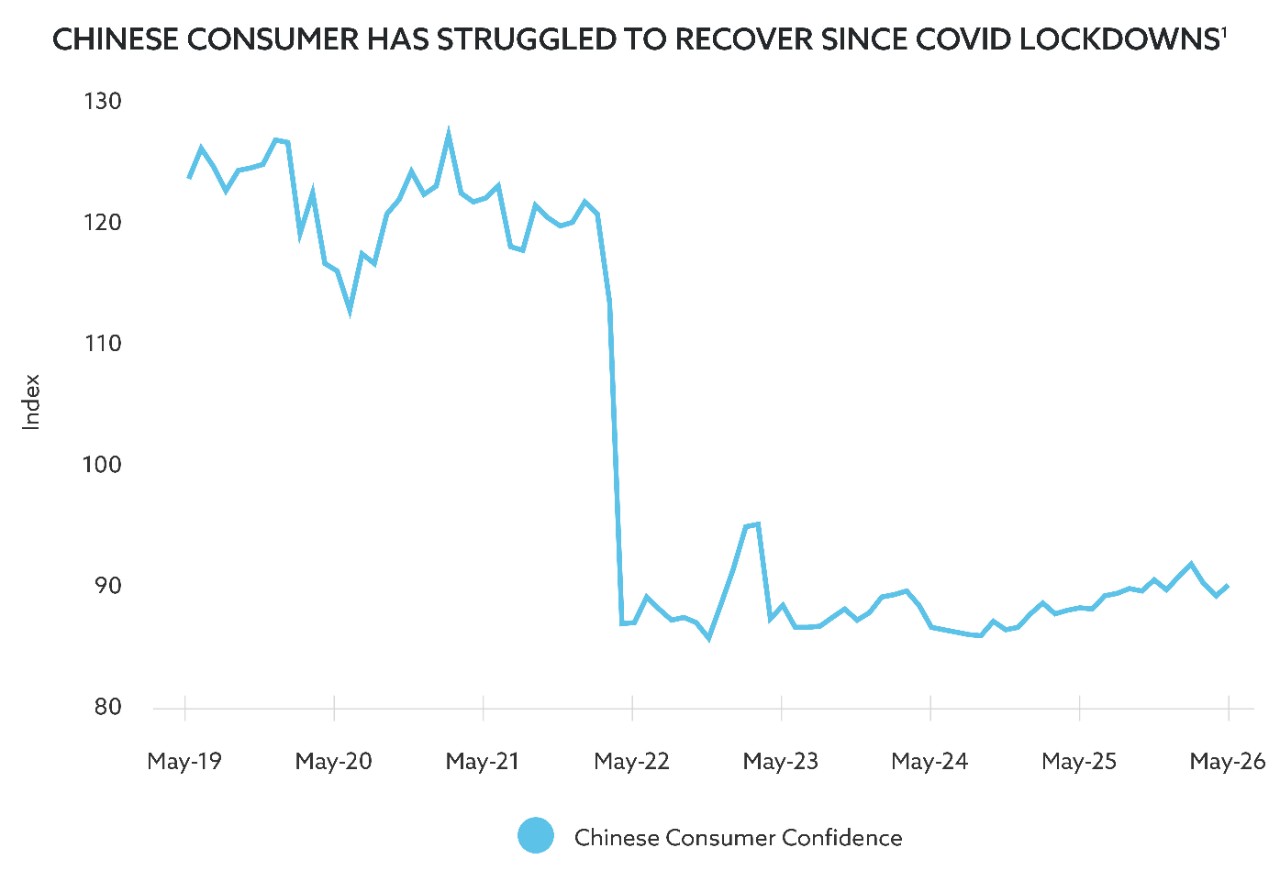
Although the official unemployment rate has shown limited change, the underlying labor market appears much weaker, with more job seekers competing for fewer available roles. Several dynamics are the main culprits, in our view.
- Graduating students may often be encouraged to pursue further education when entry-level jobs are scarce, effectively reducing labor-market entrants for now at the cost of future years.
- The freelance workforce has expanded rapidly and is estimated to have exceeded 300 million people in 2026.2 Many newly-converted gig workers may technically be considered employed, but at significantly lower income levels than in their previous full-time roles.
- Rapid AI adoption is adding to labor-market uncertainty. Even with recently announced restrictions on employers replacing workers with AI, productivity gains from automation may reduce the need for new hiring.
As the labor market becomes more fragile, we see that households’ income expectations are falling. In turn, this has led to lower discretionary spending and a higher propensity to save.
Negative Wealth Effects Accentuate Pressure on Spending
A second major constraint we see is the negative wealth effect. In China, properties have historically been the primary long-term investment vehicle, and we have observed households benefitting from decades of rapid growth in the sector. As the property market meltdown has yet to show consistent signs of recovery across cities, households’ willingness and ability to spend have weakened substantially.
This pressure has been compounded by losses across other parts of household balance sheets. The stock-market decline between 2020 and 2024 coincided with the property downturn, leaving many families exposed to losses on both sides.3 In addition, scandals involving wealth-management products have further eroded trust in China’s financial markets.4 Limited reliable and profitable investment alternatives have left households with few viable investment vehicles to grow wealth and rebuild confidence.
Taken together, we believe many Chinese families feel poorer today than they did half a decade ago. As a result, households are likely to budget more cautiously and limit discretionary spending.
Policy Support Has Had Limited Impact
The government has elevated consumption to a top strategic priority, but we believe the policy response so far has been too narrow and piecemeal to meaningfully restore confidence. Recent appliance incentives, for example, provided a temporary boost to that specific sector.5 However, the impact did not appear to meaningfully extend into other areas of consumer spending, nor did it sustain growth beyond the end of the stimulus program.
In our view, a durable recovery in consumption requires deeper structural reforms, particularly in the private sector and labor market. Without policies that materially lift income expectations and employment confidence, we believe consumption is likely to remain a laggard in China’s economy over the short-to-medium term.
Weak Consumption Has Global Investment Implications
China’s weak consumer market has implications for global growth and portfolio positioning. With production capacity continuing to outpace domestic consumption, China could remain reliant on exports to absorb excess supply and support GDP growth.
With that in mind, several investment implications stand out to us. In China, we remain cautious on property issuers and non-tech, retail-related sectors where weak household demand continues to weigh on fundamentals. Globally, we believe spending downgrades by Chinese households are negative for luxury brands and European automakers, as consumers turn to lower-cost, domestically-built products.
Author

(1) FactSet. As accessed on 28 July 2026. (2) The China New Employment Forms Research Center, via Reuters. “China's Booming Gig Economy Masks Job Market Pain, Strains Welfare System.” 6 July 2026. (3) FactSet. As accessed on 30 July 2026. (4) Examples include: Reuters. “At China's Zhongzhi, Risky Practices Preceded Shadow Bank's Collapse.” 10 September 2024. Caixin Global. “China’s CreditEase Freezes $4.4 Billion Wealth Products as Shadow Banking Risks Reemerge.” 27 May 2026. (5) BofA Global Research. “China Watch: 2Q GDP Growth Showed Broad-Based Slowdown.” 22 July 2026. Chinese home appliance offline weekly sales growth declined in areas like washing machines, dryers, fridges and televisions in late June and through 19 July.
Unless otherwise stated, the information presented has been prepared from market observations and other sources believed in good faith to be reliable. Information and opinions expressed by PPM are current as of the date indicated and are subject to change without notice. Forward-looking statements are subject to uncertainties that could cause actual developments and results to differ materially from the expectations expressed.
Past performance is no guarantee of future results. Investments involve varying degrees of risk and may lose value.
© 2026 PPM America, Inc. All rights reserved.

