


Aug. 20, 2026 | 3 Minute Read
Key Takeaway
We maintain a constructive outlook for the CLO market, in particular investment grade-rated CLO debt.
Our outlook remains constructive for the CLO market, particularly investment grade-rated CLO debt. Despite tighter valuations, we see carry opportunities and technical factors continue to provide support for spreads. We have witnessed strong and persistent investor demand for senior CLO liabilities. CLO ETFs have also become an increasingly important source of demand with approximately $50B of AUM, providing an additional structural buyer base.1
Further, regulatory developments continue to improve the investment case for highly-rated CLO debt. Recent revisions to the NAIC Risk-Based Capital (RBC) framework represent a meaningful positive development for the CLO market, in our opinion, and should encourage incremental insurance demand for CLO debt rated AAA to A. The new framework is more punitive for lower-rated tranches and incorporates tranche thickness as an important factor in determining capital treatment.
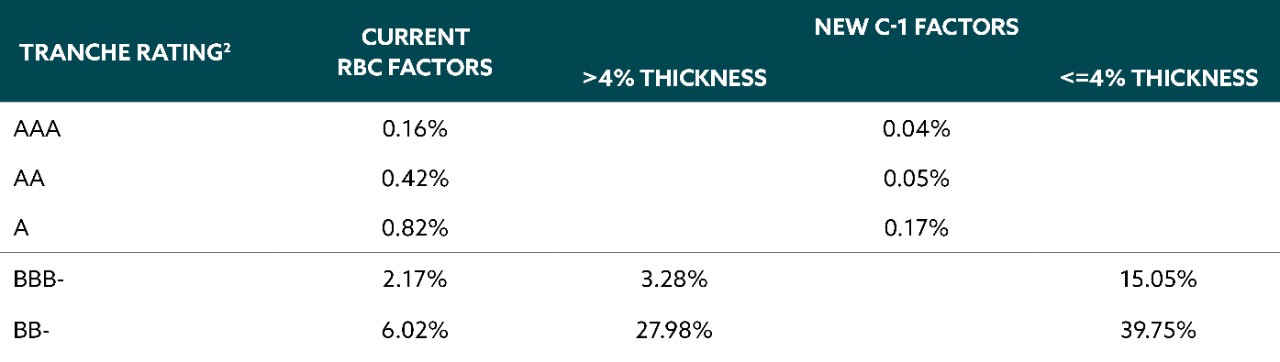
We believe benefits may extend to middle-market CLOs and rated feeder vehicles. BBB downgrade risk should be monitored closely, particularly for thinner or lower-quality tranches. Junior BBB widening may create relative value opportunities.
In terms of our credit market outlook, dispersion remains the dominant investment theme, with issuer-specific fundamentals driving performance. Loan prices have stabilized around $95 and primary issuance has gradually reaccelerated. We believe manager selection is increasingly important due to credit dispersion. In our experience, managers have continued to reduce CCC exposure and appear cautious toward weaker single B credits. At the same time, they are active participants in liability management exercises (LMEs) to improve recoveries. Similarly, we favor higher-quality credits while remaining cautious on weaker single B and CCC issuers.
We observed fears of AI disruption acting as a headwind in the broadly syndicated loan market beginning in February 2026, particularly pressuring the software sector on concerns software-as-a-service companies could be replaced by AI tools. Importantly, software remains one of the largest sector exposures in many CLO portfolios. Loan prices in the software sector have since stabilized around $90, although recoveries remain uneven.
We believe AI could reshape the software sector, increasing the importance of issuer selection. Typical CLO portfolios have roughly 5-20% software exposure, with the market average near 15%. Managers have generally reduced software allocations, and their performance appears negatively correlated with excessive software exposure. AI is expected to create both winners and losers rather than uniformly impair the sector. Some sub-sectors are more stressed than others, such as horizontal software, network systems and cyber security.

(1) BofA Securities via PitchBook. “BofA: US CLO ETFs Surge Past $50B in AUM; Inflows Total $10B YTD.” 10 July 2026. (2) Mayer Brown. “The NAIC RBC Investment Risk and Analysis (E) Working Group has Made Its Decision on New Life RBC Factors for CLOs.” 25 June 2026.
Unless otherwise stated, the information presented has been prepared from market observations and other sources believed in good faith to be reliable. Information and opinions expressed by PPM are current as of the date indicated and are subject to change without notice. Forward-looking statements are subject to uncertainties that could cause actual developments and results to differ materially from the expectations expressed.
Past performance is no guarantee of future results. Investments involve varying degrees of risk and may lose value.
© 2026 PPM America, Inc. All rights reserved.

